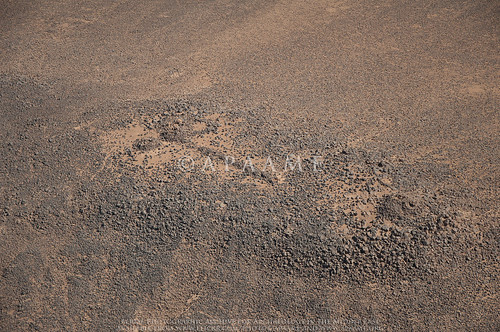
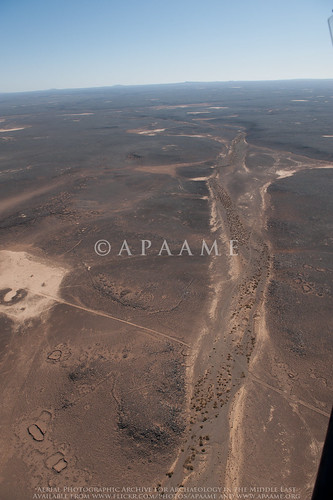
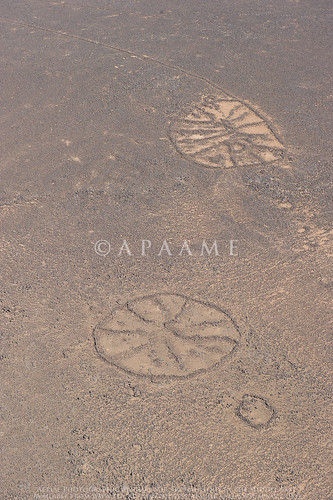
Showing posts with label Aerial Imagery. Show all posts

Wednesday, 26 October 2016

Jerash Mausoleum 3D view


David Connolly’s excellent 3D view of one of the large - and seriously endangered, monumental tombs beyond the walls of Roman Gerasa. Photographs are a mixture of his ground photographs and others taken from the air as part of the Aerial Archaeology in Jordan project.

Click here to view the Jerash Mausoleum 3D model

He has also made a 3D model of Kh. el-Beddiyeh - an excavated settlement site in the Ajlun Highlands.

Tuesday, 14 June 2016

AAJ May 2016 - Highs, Lows, and Goodbyes to the Hueys

When we are in Jordan we will squeeze in any opportunity to fly, but this year it was particularly important to do a few flights as we have sadly lost the use of the wonderful beast of helicoptering - the Huey, and we had to test our new machines and pilots of the Eurocopters.
Jafr AFB
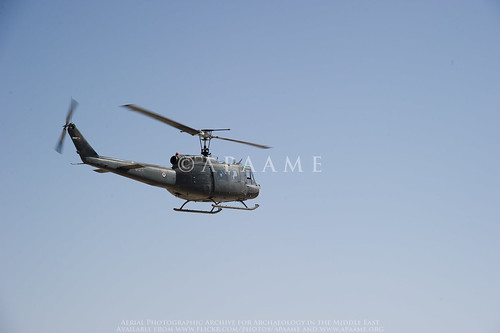
One of the RJAF Hueys in flight during the 2010 season. Photographer: Don Boyer. APAAME_20101016_DDB-0045.
The Huey has been our principal form of aerial reconnaissance since the Aerial Archaeology in Jordan project started in 1997. The advantages of the Huey were its spacious interior, large opening (once the door was open) and outward facing seats that allowed four photographers to operate together. Given these machines had been in operation during the Vietnam War (see our blog 'I Love the Smell of Nabataea in the Morning'), and one had a bullet hole to prove it, we knew we would have to move on eventually. They had their quirks, like the communication systems being flakey, shaking you about so that you could feel the movement for several hours after landing, and the noise! We felt a pang of grief for the loss of a trusted friend that had transported us over the varied sites and landscapes of Jordan. If anyone has a few million pounds to service a small fleet of Hueys for us, I am sure we could make good use of it!

Saturday, 28 May 2016

Flight 20160526 - East into the Badia

The second flight of the 2016 season saw Becc and I heading east to the Azraq area, taking in Qasr Aseikhim, a wonderful and significant multi period hilltop site but which is suffering badly from the bulldozer as access roads make it more accessible.
Qasr Aseikhim showing signs of damage from bulldozing. Photographer: Rebecca Banks. APAAME_20160526_REB-0132.
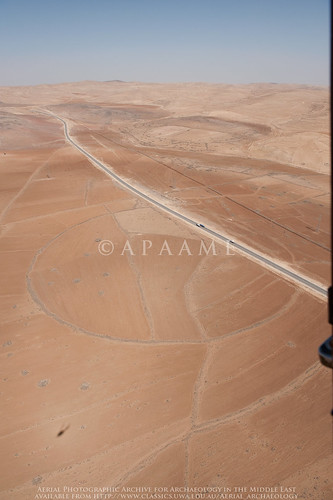
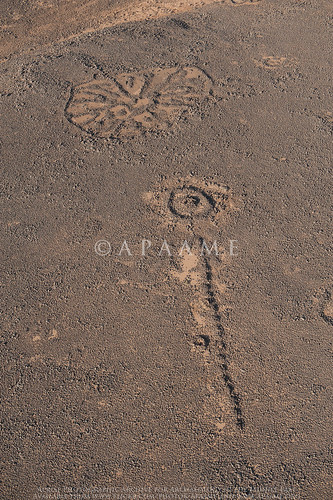
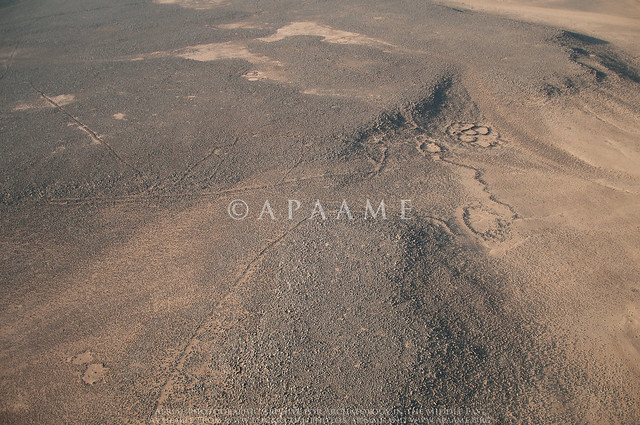
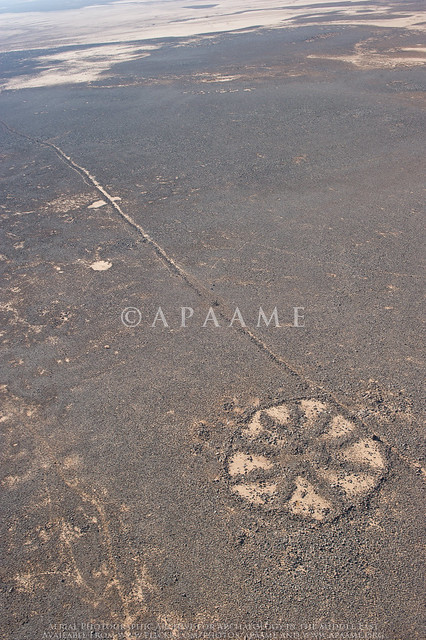
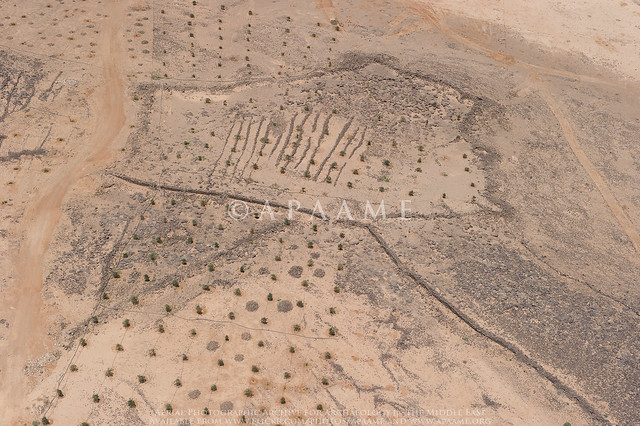
We then headed to assess the impact of the construction of the Azraq by-pass on the stone built structures on the Harrat al-‘Uwaynid. It was truly depressing seeing what had been destroyed without thorough investigations (a presentation at ICHAJ13 by Romel Garib said a survey had been conducted with the help of Prof. Gary Rollefson, but no excavation); truly a missed opportunity as the area is rich in kite-sites, wheels, and pendants (one of which we have been monitoring and has had its tail smashed through – seemingly unnecessarily). These sites are representative of this part of the basalt plateau, and we know so little about them.

Thursday, 15 October 2015

FL20151014 - A fond farewell above Amman

Today was the final day’s flying of the 2015 season; we had hoped to fly at least one more trip but the weather intervened earlier in the week and the option of flying on the 15th was removed when the government announced that the Al Hijri New Year holiday would be on the Thursday, giving the Jordanians a long week-end.
Rebecca Banks and Jane Taylor getting ready for our last flight.
However there was a highlight, in that we were joined by Jane Taylor, author of the High Above Jordan and renowned photographer. It was Jane’s work which gave David Kennedy the inspiration to attempt to start an archaeological flying campaign; she blazed the trail which opened up access to the Royal Jordanian Air Force and she has been a great friend ever since, and supporter of our work.
The excavated site of Al-Kanisah Monastery west of Madaba.
The plan for the day was the greater Amman area, initially heading south for reconnaissance in the Madaba area – such old favourites as Rumeil, still looking in good condition but the terracing along its slopes becoming much more pronounced since we first photographed it in 1998 (see Ancient Jordan from the Air, pages 106-7).
The site of Rumeil.
Then on to Khirbat al-Mudayna, in the Wadi ath-Thamad, a substantial, defended hilltop enclosure, much changed since we were there in 1998 (ibid:112-113). It is an Early Iron age site, with its defences being started in the 9th century BC. The excavations have revealed the first ever excavation of a Moabite temple, and complexity of buildings which could only have been guessed at from its seemingly smooth surface. It may have been the site of Jahaz, the place name in the Bible of the battle between Sihon of Heshbon and the Israelites (Numbers 21, 21-4).
The excavations at Khirbet al-Mudayna.
We returned north to the now metropolitan landscape and were spoilt to a fly past the citadel of ancient Amman, a rare treat as air traffic is so restricted in the city centre.
Amman Citadel.
We refuelled at Marka and said our farewells to Jane, who we hope to see again in the skies above Jordan next year.
Quweismeh Tomb hidden amongst the modern urban fabric of Amman.
We returned to the air, this time just the two of us (Becc and Bob), to an intense 90 minutes of photography of targets, often crammed between roads, houses or hidden in trees. This may be the last chance to photograph some of these sites as the pressure for building land intensifies in Amman. The influx of refugees and others seeking work has made this city one of the fastest growing places in the Middle East.
Qasr Khilda, now sandwiched between urban apartment buildings.
Flying and photographing over cities is the most challenging of all aerial photographic missions; communication between pilot and photographer is key, as the targets are both difficult to spot and are so close together. Add to the mix the noise from “air traffic control” from the airport; continuously managing other traffic and then telling us that we can’t stay there and have to move away. Safety first, thankfully, given the proximity of some large buildings; at one point I was asking the pilot to orbit right – as I was looking out of the side of the helicopter; he replied “but doctor there is a large building in the way....” He is in charge so we went round the building.
"but doctor there is a large building in the way..." - photographing in Amman.
As this was our last flight of the season it is right to commend and thank all the pilots and staff of the RJAF for their professionalism and skill in taking us on these archaeological hunts, and bringing us back safely. We have covered the length and breadth of the country in almost 30 hours flying, and photographed many sites which we have not been seen before; sites under great threat and others which we hope will remain untouched for a long time to come.

FL20151013 - From Wadi Feinan to Wadi Mujib

We were joined on this trip by Isabelle Reuben, archaeologist and resident of Jordan for many years. We started as early as possible as we had a long transit flight down to the Wadi Feinan, some 80 nm south. The pilot treated us to a low-level fly past of Kerak castle, bathed in the orange glow of the rising sun.
Kerak.
A haze layer had settled over the Wadi Feinan but the light was still good enough for our photography. This is an area which has been well surveyed, by many overseas teams and a number of sites have been excavated too. In this instance, our photography was at the request of the University of California, San Diego Edom Lowlands Regional Archaeology Project.
The site of Feinan through the morning haze.
Sites we hadn’t seen before were also photographed, as was even more evidence of looting.
Looting in the Dead Sea valley east of Mazra'a.
Once again our re-fuelling air base was Al-Jafr and flying from the western fertile plateau it was striking just how quickly the agriculturally successful plains give way to almost completely barren basalt-strewn limestone as we fly east.

We had our first experience of a Jordanian wind farm, and on the return from our pit-stop the pilots decided to fly through middle of the them, rather than divert around, so we were able to capture some close ups of the turbines.
A windfarm.
The day was one of contrasts from long transits to intense photography of sites on the summits of dramatic wadis, and a descent into the margins of the Dead Sea and then up to the relative greenery of the fertile Kerak plateau.
The dramatic location of Gosa/Qosa al Hamra.
It is always good to have another, new, pair of eyes in the helicopter; Isabelle was no exception as she knows the landscape of Jordan so well and sees so much more, including the swarm of butterflies at the bottom of the palm tree outside the squadron building at Al-Jafr.
Butterflies at Al-Jafr.

Tuesday, 14 October 2014

Flight 20141013 - Flying South

Qasr Mshatta under cloud - © APAAME_20141013_REB-0028
The second day of the season started with good weather and permission to go south and be allowed access to Qasr Mshatta (an Islamic hunting lodge) now situated on the north edge of the runway at Queen Alia International airport. Unfortunately on arrival the site was cloud-covered but we were welcomed by a wonderful waft of bread being baked in the nearby factory. We moved on south to Machaerus – famous (or infamous) for being the location where John the Baptist lost his head, thanks to Salome’s nefarious activities. It was the subject of a siege by the Romans, trying to recapture it after the Jewish Revolt (AD 66-70), and now undergoing excavations by a Hungarian team.  The siege works are still visible with approximately 10 Roman camps on the surrounding hills.
Machaerus - © APAAME_20141013_RHB-0063
Further south, near the southern edge of the Dead Sea we photographed looting, on a massive scale, of the cemeteries around Fifi, Safi and al-Mazraa (Kh. Qazone).  Our spirits were lifted by some photography of Umm-er Resas (a superb Roman fort and later Islamic town and early seat of learning); then by a return to visit to Qasr Mshatta, this time bathed in sunshine and the smell of bread,  even more appealing as lunch-time approached.
Extensive looting near Safi - the site of Maqbarat Al-Nage'a - © APAAME_20141013_REB-0307
Umm er-Resas - APAAME_20141013_REB-0224
On our third and final trip, and looking for the last site of the day we were having difficultly locating it, not least because of having to keep away from approaching air traffic into Marka (our base) but also because the whole area had been eaten away by massive stone quarries.  We spotted a possible location and as we orbited we realised that we had stumbled across an abandoned Roman (?) quarry with stone columns and sections of unfinished stone,  still visible in the limestone outcrop.  Once again a hugely important site, within a few metres of large destructive modern quarries.  Our pilot (who was having to work on his birthday) took us down to a few feet above the site so we could record it in detail.

Roman (?) Column Quarry east of Marka APAAME_20141013_MND-0768
 - Robert Bewley

Wednesday, 3 September 2014

Publications: Kites in 'Arabia' (iBook)

Apple iBooks has just published (1 September) a new book by Prof. David Kennedy with Rebecca Banks and Emergent Form's Paul Houghton on Kites in 'Arabia'.

Kites in 'Arabia'
David Kennedy with Rebecca Banks and Paul Houghton
September 1, 2014
iBooks for iPad or Mac OS X 10.9 or later
Emergent Form
225 pages
US$4.99/ AU$5.99/ £2.99
Edit 25/20/2016 - the iBook is free to Download.

The book offers an approachable survey and analysis of the stone built structures known as Kites  found throughout Arabia - the huge arid region extending from south-eastern Turkey through Syria, Iraq, Jordan and Saudi Arabia to Yemen.  The volume examines Kites from their first discovery by the RAF pilots who were the 'Pioneers' of aerial photography in the inter-war period in Transjordan to recent research and interpretation conducted by various professionals in the field. Distribution, form and function of the Kites is discussed and extensively illustrated with references provided throughout. The volume benefits from David Kennedy's long established interest and passion for aerial photography and archaeology in the Middle East, and draws on the extensive reconnaissance performed by the Aerial Archaeology in Jordan Project and historical imagery research of the APAAME Project. The book also includes extensive appendices illustrating types and locations of Kites across 'Arabia', and historical accounts of Kites by early explorers in the Middle East.

The medium of iBook was chosen for two primary reasons: accessibility and inclusion of illustrations. We have made the iBook available for just US$4.99/ AU$5.99/ £2.99 to make the publication affordable. Images have been profusely included to illustrate the features described, something that would have astronomically increased publication costs in a printed edition. Moreover the electronic format allows for interactive features which enhance the illustrative elements and for video interviews and footage taken from the helicopter.

Heavy on content, the iBook does come out at roughly 1GB to download, but fortunately will only ever be as heavy as carrying around your laptop or iPad.

Monday, 3 February 2014

Publications: Remote Sensing and ‘Big Circles’ A New Type of Prehistoric Site in Jordan and Syria

The most recent annual edition of the periodical Zeitschrift für Orient-Archäologie (ZOrA) features a research article by Professor David Kennedy on a series of 'Big Circle' stone structures.
Circle 3
APAAME_20081008_DLK-0287 Photographer: David Kennedy.
Abstract from the article:
Circular stone structures are common throughout the Middle East and can date to almost any period. To date at least 12 examples have been recorded in Jordan but now a single further example near Homs in Syria has been published. The latter is one of the few to have been examined in some detail on the ground; most are known only from brief reports although all the Jordanian examples may be viewed on the Flickr site of the Aerial Photographic Archive for Archaeology in the Middle East (APAAME). Dating is problematic in every case, though they seem certainly to be pre-Roman.

David Kennedy (2013) Remote Sensing and ‘Big Circles’: A New Type of Prehistoric Site in Jordan and Syria, Zeitschrift für Orient-Archäologie 6: 44-63.

Thursday, 17 October 2013

Seminar: David Kennedy. “Al-Muwaqqar. Salvaging an Umayyad Desert Castle and its Context”

On our recent fieldwork in Jordan in April we paid particular attention to the Umayyad site of al-Muwaqqar on the fringe of the steppe east of Amman (see our blog entry: Flight 20130414, Field Trip 20130416 - al-Muwaqqar). Our interest has only increased with subsequent detailed examination of previous travellers’ and archaeologists’ reports, photographs and drawings of the site – the first date to the late 19th century include John Gray Hill and his wife Caroline, Rudolf-Ernst Brünnow and Alois Musil. Later accounts include the better-known publications on the distinctive capitals by R. W. Hamilton, and K. A. C. Creswell, author of Early Islamic Architecture (1969) as well as the lesser-known excavation reports published in the Jordan Department of Antiquities Journal, ADAJ. In addition to this there are historical aerial photographs of 1939 and 1948, and our own photographs of the site dating 1998-2013. Piecing together these accounts with the surviving visible record has led to an impressive picture of a complex Umayyad site comprising of at least 2 reservoirs, c. 90 cisterns, a large Qasr or palatial residence, a second structure of unknown function, and what may be an associated bath-house with mosaics.

A brief summation of our investigations were presented today at St. John’s College, Oxford at one of the weekly ‘Late Antique and Byzantine Archaeology and Art’ Seminars. The lecture was well attended. Positive and informative feedback from peers was most welcome and has given us much food for thought. The resulting publication on this topic is in the works: watch this space.
David Kennedy presents in the New Seminar room at St. John's College, Oxford.

Wednesday, 17 April 2013

Flight 20130414, Field Trip 20130416 - al-Muwaqqar

Cropped section of RAF Topographical photograph dated 14 September, 1948 showing Al-Muwaqqar before the modern village was built.
Looking at the site of Al-Muwaqqar on historical RAF photographs from the 1940s, we were puzzled by a rectangular dark shape that resembled the outline of a small reservoir, south east of the known desert castle and south-west of the known large reservoir. Overlaying the photograph in Google Earth allowed us to pin point a GPS coordinate to investigate from the air, which was done on our second flight of the season - 14 April, 2013.
Aerial photograph taken 14 April 2013 with features indicated. © APAAME_20130414_DLK-0013
During our flight we thought we did not find the site, suspecting it had since been built over or buried by time. We did see exposed walls and mosaics of a recently excavated site - possibly a mansion or bath building, which we did photograph (Mega-J 58371 'Mwaqer Mosaic House'). Upon a closer look at the photographs post flight, a large wall to the west of the 'mansion' was clearly evident. We had indeed found the site we were looking for - but was it a reservoir wall?
Exposed section of 'reservoir' wall. © APAAMEG_20130416_MND-0013.
'Mansion'? © APAAMEG_20130416_MND-0016.
A quick ride in the car east of Amman on the road towards Azraq enabled us to follow up what we had photographed. Indeed, the wall west of the 'mansion' was substantial, moreover, the possible evidence of waterproofing with cement was apparent - though ancient or modern we do not know. An associated double wall was just evident on the surface running off diagonally from the south-western corner of the structure to the north-west. The eastern extent of the reservoir was not readily apparent. The section of excavated 'mansion' next to it had a beautifully paved floor, at least three mosaics (one almost complete), and evidence of at least two building events - one with large square stone paving blocks, a later one of tile and mortar. The whole site unfortunately was being impacted by construction waste being dumped in the area, and was cut by a road, drain and the construction of a neighbouring house.
Aerial photographs taken by the AAJ in 1998 and 2008 (Click to enlarge).
We also visited Qasr al-Muwaqqar, an Umayyad Desert Castle now overlain by the modern town. This site had also been much impacted by modern use; new concrete houses have encroached on this site, and some of the vaulted rooms appear to have been converted into early modern houses (complete with traditional reed and mud roofs), much like what has occurred as Qasr Azraq. These houses are now used as livestock pens by local residents. Rubbish is also dumped on the site. Sandstone columns and a regularly paved floor attested to the Qasr's former glory. The numerous ornate column capitals from the site have long-since been removed, as has the stone water-gauge.
Goat pens at Qasr al-Muwaqqar.
© APAAMEG_20130416_DLK-0052.
Paving Qasr al-Muwaqqar.
© APAAMEG_20130416_REB-0026.


The large reservoir of el-Muwaqqar is visible from the road. The site has been restored and is functional - still half full from the season's rains.
Large reservoir at Al-Muwaqqar. © APAAMEG_20130416_DLK-0058.
All photographs from the flight and ground visit will be available on Flickr shortly. http://www.flickr.com/apaame/collections. Follow us at @APAAME on twitter for updates.

Tuesday, 16 April 2013

Flight 20130414 - Finding El-Mushaggar

El-Mushaggar. © APAAME_20130414_DLK-0191.
We took pictures of this village because there were old reports it had once had archaeological remains. All we could see was this roofless relatively modern building in the middle of the current cemetery. But if you zoom in on the doorway you see it consists of two reused ancient columns with some column stumps in the wall nearby.
Close up of the re-used columns.
 -DLK

Thursday, 28 February 2013

Historical Imagery - Berlin

As you may have noticed, we use Google Earth quite often to investigate ancient sites and how the landscape and site has changed in comparison with historical imagery.

Google Earth has a tool button that allows you to see historical imagery (if there is any) of an area  - in many cases the imagery dates can differ just a few years, but the changes can be drastic with urban expansion, natural disaster and other impacts vividly changing a landscape in just a short period of time.

You can view a period in the slightly more distant past over Berlin, Germany, a period that is particularly poignant to many people living today. Google Earth has extended its historical imagery for the site of the city of Berlin to two phases of aerial imagery during (1943/1945) and post World War Two (1953). The overlay appears to be made from a mosaic of aerial survey photographs, probably created by the United States Army Air Force (USAAF) and/or Royal Air Force (RAF), or aerial photographs confiscated from the German Air Ministry after WW2. For example, the United States National Archives Collection of Foreign Records Seized includes the following:

242.9.4 Other air force records
Aerial Photographs (8,000 items): Target dossiers of sites in Europe, North Africa, and the Middle East, with each dossier consisting of a map, an overprinted aerial photograph, and a site description, 1938-44; aerial photograph studies relating to specific types of targets in the United Kingdom, France, and the USSR, 1940-44; aerial mosaics of coastal areas in the United Kingdom and France, 1942-43; aerial prints and anaglyphs of central Italy, 1943-44; and aerial photographs of North African and Mediterranean sites, compiled for the German X Air Corps war diary, 1941-44. <http://www.archives.gov/research/guide-fed-records/groups/242.html>
These Aerial Photographs are linked to the records for Topographical Maps (242.25 Cartographic Records (General) (1910-18, 1935-45), and therefore probably include survey photographs.

Using the Historical Imagery tool you can change between the two phases and see the change from ruined buildings and bomb craters, to cleared land and some rebuilding.
Berlin 1953. Large parcels of city blocks of bombed ruins have been cleared. Image: Google Earth. Click to enlarge.
The capitals of London, Paris, Warsaw and Rome have also been overlain with historical aerial imagery. London and large areas of the south-east of Britain use one phase of imagery in 1945, Paris with two phases of 1943 and 1949, Warsaw with pre-WW2 imagery of 1935, and one of 1945, and Rome dating to 1943. Other smaller centers include Dortmund, Hanover, Leipzig, Cologne, Frankfurt, Wiesbaden, Koblenz, Nuremberg, Regensburg, Dresden, Wroclaw, Gdansk, Hamburg and Lubeck to name a few also have black and white historical imagery overlays.

Tuesday, 18 December 2012

Publications - Historical Aerial Imagery in Jordan and the Wider Middle East

Hot off the press!
Robert Bewley and David L. Kennedy, 2013, 'Historical Aerial Imagery in Jordan and the Wider Middle East' pp. 221-242 in: William S. Hanson and Iona A. Oltean (eds) Archaeology from Historical Aerial and Satellite Archives, Springer: New York/Heidelberg/Dordrecht/London.
ISBN: 978-1-4614-4504-3

The book or eBook can be purchased from the Springer website: http://www.springer.com/social+sciences/anthropology+%26+archaeology/book/978-1-4614-4504-3

Friday, 14 December 2012

Publications - APAAME photo in December issue Antiquity

Safawi Pendant 52, Safawi Wheel 290
APAAME_20120522_DLK-0096. Photograph: David L. Kennedy
Featuring in the latest issue of Antiquity is this photograph taken by David Kennedy on the 22 May 2012 during our last season of flying in Jordan. You can read more about the photograph and its features in the journal's Editorial:
Editorial, Antiquity, Vol 86 No 334 December 2012: 966. http://antiquity.ac.uk/journal.html#editorial

Tuesday, 14 August 2012

APAAME in the Biblical Archaeological Review

Picture
Machaerus. APAAME_20060910_DLK-0005. Photographer: David L. Kennedy
Győző Vörös' article in the Biblical Archaeological Review this month explains some fantastic progress since 2009 at the site of Machaerus in Jordan being conducted by the Hungarian Academy of Arts, in collaboration with the Jordanian Department of Antiquities. The article features some of APAAME's images from the region of Machaerus, as well as some stunning shots by Jane Taylor. You can find the article here: Machaerus: Where Salome Danced and John the Baptist Was Beheaded.
If you would like to see more images of the site of Machaerus, please visit our Flickr Archive.

Wednesday, 25 July 2012

Greater Zarqa, Jordan

Google Earth Screen Capture of urban development near Zarqa, north-east of Amman, Jordan. Click to enlarge.
In our last blog post we mentioned the impact of the expansion of the urban areas of Amman. While cataloguing historical imagery in our collection today, I have stumbled upon a perfect example which I was able to overlay in Google Earth after a bit of difficulty finding the location due to the extent the landscape had changed.

The image above is dated 22 August 2011. It does not differ much from the imagery dated eight years earlier below.

Google Earth Screen Capture of the same area as above, dated September 2003. Click to enlarge.
Compare, however with this RAF photograph taken in 1951.
Aerial photograph layered in Google Earth. Photograph V13RAF612 28 June 1951. Click to enlarge.
The contrast between the two images, fifty years apart, shows that the landscape has completely been transformed by the modern urbanisation of greater Amman to the south and Zarqa to the north-east. This specific area is of interest due to the location of el-Hadid (see Kennedy, D.L. 2002, 'Qaryat al-Hadid: a 'Lost' Roman Military Site in Northern Jordan', Levant, 34: 99-110), which you can see pinned in the top right of the screen captures. In the area specifically covered by the RAF photograph, however, we can see no trace of built remains on the surface except fields along the Wadi Zarqa.

Thursday, 14 June 2012

Flight 20120522: Now online

We have been busy cataloguing the second of our two flights in Jordan last month, and you can now access the photographs on our Flickr archive.


David Kennedy, Mat Dalton and Don Boyer flew five hours in a Eurocopter to capture some 1700 images of archaeological features and the landscape. Here is a selection.

Qattafi Kite 34
Qattafi Kite 34. Note how the guiding walls narrow along the natural curves of the landscape, and the head is hidden behind a ridge.
APAAME_20120522_MND-0005. Photographer: Mat Dalton.
Safawi Pendant 65, Safawi Pendant 64
Looted Cairns. The heads of Safawi Pendants 64 and 65 have both been hollowed out by illicit excavation.
APAAME_20120522_DLK-0312. Photographer: David Kennedy.

Safawi Wheel 88
Safawi Wheel 88 intercepting the tail of Safawi Kite 7. APAAME_20120522_DDB-0242. Photograph: Don Boyer.
Qasr Aseikhim
Qasr Aseikhim. APAAME_20120522_DLK-0653. Photograph: David Kennedy
Azraq Kite 46 (Rees A)
Azraq Kite 46, overlayed by modern agriculture. APAAME_20120522_DDB-0667. Photographer: Don Boyer
Safawi Pendant 67
Safawi Pendant 67 with a well built and in tact head. APAAME_20120522_DLK-0308. Photographer: David Kennedy.

Tuesday, 5 June 2012

Flight 20120520: Now online

Our first flight for 2012 is now uploaded to our flickr archive. You can browse the images here.

This flight focused on the stone built structures known as Kites located in the basalt desert of Jordan, but also captured other structures known as Wheels and Pendants. In particular, we were interested in the landscape and other structures surrounding the Kites, and how these features interact.

Here are some highlights. Please click on the images to enlarge (you will be sent to the image on our flickr site).

Hibabiya Kite 55
Hibabiya Kite 55 
 
Amra Kite 22 
 
Ausaji Pendant 16, Ausaji Cairns 9, Ausaji Cairns 8 
 
Ausaji Wadi 1 
 
Ausaji Wheel 20, Ausaji Kite 19, Ausaji Wheel 81