Friday, 2 May 2014

Conference: 9th ICAANE Basel, Switzerland, June 9-13, 2014


Icaane LogoThe 9th biannual International Conference on the Archaeology of the Ancient Near East is coming up in June of this year. The Conference is being hosted by the University of Basel (Kollegiengebäude der Universität Basel)

You can find all the information you need on the conference website: http://9icaane.unibas.ch/

We will be presenting Kites in Saudi Arabia in the 1st session of the workshop Desert Kites - Archaeological Facts, Distribution and Function.
Abstract: Although it has long been known that Kites were to be found in Saudi Arabia, it is only very recently that the availability of high-resolution imagery on Google Earth and Bing Maps has enabled researchers to identify them far more widely and in greater numbers than previously believed. In particular, imagery for the areas around Khaybar and Al-Hiyat revealed over 200. Now the high-resolution imagery has been extended more widely and a fuller picture can be formed. The Kites are varied in size and shape but many are of a distinctive, angular form not found elsewhere in ‘Arabia’. With an increased data set, greater familiarity with the wide variety of other, probably contemporary, stone-built structures in the region, and with the geological and vegetational environment, there is an opportunity to offer a more detailed analysis and interpretation than previously done by Kennedy and Bishop.

You can download the full list of workshops complete with abstracts here: http://9icaane.unibas.ch/ICAANE2014workshopsprovisional.pdf

Conference: Big Work for Small Planes – Using UAVs and Kites for Archaeology, Berlin, May 23-24, 2014

TOPOI house Dahlem in Berlin will be hosting a symposium organised by the ArchaeoLandscapes Europe Project (ArcLand) and the Berlin Free University Excellence Cluster Topoi on the use of UAVs (Unmanned Aerial Vehicles) for archaeology and cultural heritage.


The program has been released, you can find it here: https://community.topoi.org/de/web/uav-2014/programm

We are looking forward to the presentations and hope to see you there.

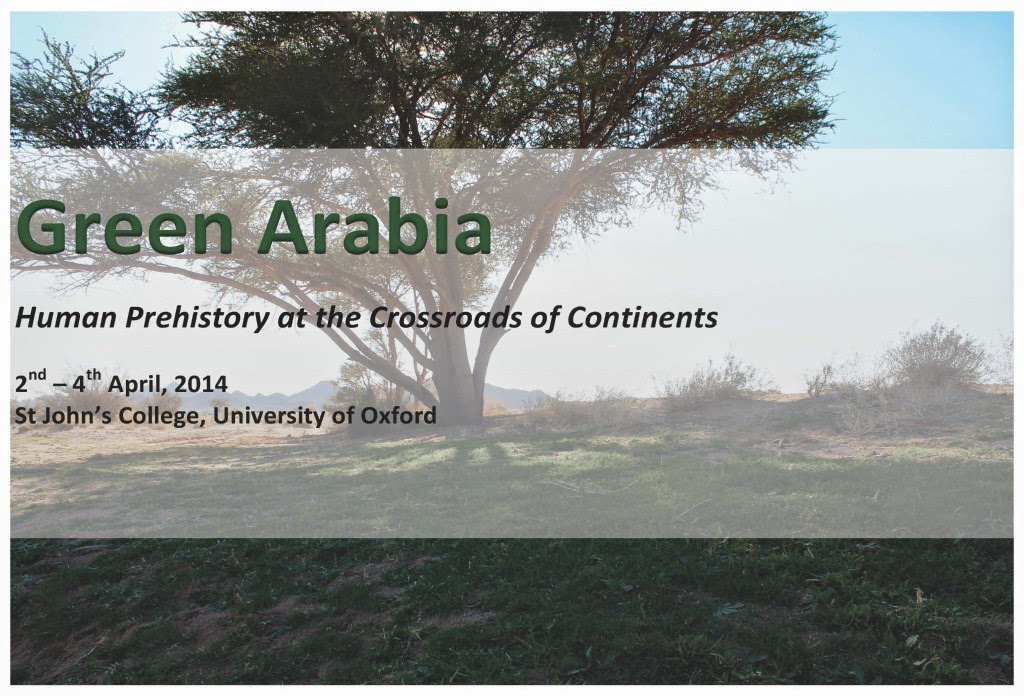
Conference: Green Arabia, Oxford April 2-4, 2014

http://www.palaeodeserts.com/?page_id=2874
In April 2014, the University of Oxford and Paleodeserts Project hosted an international conference called ‘Green Arabia’. It was sponsored by the Saudi government, launched by HRH Prince Sultan Bin Salman Bin Abdulaziz al-Saud (President of the Saudi Commission for Tourism and Antiquities, a former air force pilot and Space Shuttle astronaut) and Prof. Ali Ghabban (Director General of the Department of Antiquities). The entire proceedings were under the auspices of a significant recent development, ‘The King Abdullah Heritage Initiative’.

What has this all got to do with Roman or Aerial Archaeology, or Remote Sensing for that matter? Saudi Arabia is huge – over 2 million km2, but its archaeology is barely known to the wider world and the vast majority of its sites are uncatalogued. A large part of the country – the Hedjaz in the northwest, was once part of the Nabataean kingdom and of the Roman province of Arabia (largely modern Jordan). There are superb Nabataean sites in the Hejaz (especially Mada’in Saleh) and there have been important excavations there in recent years. Several Latin inscriptions from the kingdom attest to the Roman presences, especially that from the island of Farasan at the far south of the Red Sea.

The present initiative to open up archaeological research in Saudi Arabia is a welcome development.

You can see the opening remarks by HRH The Prince of Wales and HRH Prince Saltan Bin Salman on the Paleodeserts' website: http://www.palaeodeserts.com/?page_id=2874, where you will also find the conference details and abstracts.

Thursday, 24 April 2014

Publications: 'Nomad Villages' in North-Eastern Jordan


The May 2014 edition of Arabian Archaeology and Epigraphy features a new publication by David Kennedy.


Arabian Archaeology and Epigraphy 25.1 May 2014'Nomad Villages' in north-eastern Jordan: from Roman Arabia to Umayyad Urdunn
David L. Kennedy
Arabian Archaeology and Epigraphy, Volume 25 (May 2014): 96-109
Available through Wiley Online Library : http://onlinelibrary.wiley.com/doi/10.1111/aae.12033/abstract

Contemporary with the well known and striking Desert Castles and Qusur of the desert steppe in the early Islamic period in the Near East emerged another group of sites - dispersed villages, here termed 'Nomad Villages'. Kennedy's article, amply accompanied by photographs and plans, augments recent discoveries and fieldwork to enrich our knowledge of the traces of these dispersed settlements.

Tuesday, 15 April 2014

Workshop: Introduction to Aerial Archaeology March 2014

At the beginning of March this year you may remember that our Bob Bewley was about to hold an Aerial Archaeology Workshop with Dr Fawzi Abudanah at the Department of Archaeology, Al-Hussein Bin Talal University, Petra, Jordan. 

Initially it was intended the workshop would accommodate ten students drawn from the campus’ Archaeology and Tourism courses. Increased interest in the course saw numbers rise at times to twenty students, so the workshop adapted to be delivered in a lecture/seminar style over three days (March 2nd – March 4th).

Students experiencing aerial photography in 3D - thanks to some old-school glasses.
Talks and presentations gave way to seminar and group discussions on air photo interpretation. This included time devoted to ‘photo reading’ where students were given the opportunity to develop their practical skills in interpretation and observation and produce plans in a final mapping exercise. Due to variability in the understanding and speaking of English, Dr Abudanah translated to and from Arabic for the benefit of students and Dr Bewley. This had the added advantage that students had more time to consider what was being said and/or shown to them. The in-depth discussions that followed demonstrated the interest of the students and their developing understanding on the nature and use of aerial survey for archaeology.

Students work on a photo reading and mapping exercise.
It is hoped a small number from this course will now be able to join the Aerial Archaeology in Jordan Project for a day or so in the planned aerial reconnaissance season in October 2014 to continue their training.

Thanks must be given to Dr Fawzi Abudanah for facilitating and helping organise the Workshop, the Department of Archaeology at Al-Hussein Bin Talal University for hosting, the Palestine Exploration Fund’s grant for Dr Bob Bewley’s participation, and the support of the Packhard Humanitites Institute for the continuing Aerial Archaeology in Jordan project.
Workshop participants with Dr Bob Bewley, Dr. Saad Twaissi (Dean of the Petra College for Tourism and Archaeology) and Dr Fawzi Abudanah in the front row (from the right).

Monday, 10 March 2014

Archive: UPenn Museum of Archaeology and Anthropology Film Archives

"The formidable mountains of Arabia Petraea still loomed miles away."


The Film Archives of the University of Pennsylvania Museum of Archaeology and Anthropology have been digitised and made available online thanks to the generosity of the 'Internet Archive'.

A silent film by Arthur and Kate Tode from 1930 is an interesting glimpse of travel in the Middle East between the wars. There are some stunning views of Petra [4:01] including a rare occurrence of  snowfall [17:05] (apparently the first time it had snowed in Petra in 30 years), footage of the Umayyad Mosque of Damascus [24:02], the Ctesiphon Arch [33:00], the ruins of Babylon [37:14] and Ur [43:00], and also some aerial footage towards the end [50:30].

The Internet Archive site provides a transcript of the silent film's narrative.

You can access the University of Pennsylvania Museum of Archaeology and Anthropology Films collection at The Internet Archive here.

You can access the Museum website here: http://www.penn.museum/archives.html/film-archives.html

Tuesday, 4 March 2014

Research - KSA 3925-41 - Samhah Kite 35

I have been able to return to some analysis on the many kites in the vicinity of Khaybar in Saudi Arabia today. The good news is that Google Earth has updated imagery in the area, bad news is it looks like some of the kites are a little worse for wear in the face of development. Fortunately we still have the historical imagery to conduct some analysis on the complete site - a bold example of the Kites typical to this region. What is striking in this example is the very straight walls, and numerous hides lined along the pointed extensions of the head. Another feature is the 'barbed' tails of the kite - almost secondary head enclosures connected to the tails close to the head of the kite.
KSA 1:50,000 map square 3925-41 - Samhah Kite 35 on imagery dated 20030106. Click to enlarge.
KSA 1:50,000 map square 3925-41 - Samhah Kite 35 on imagery dated 20121213. Click to enlarge.