Showing posts with label Airmail Route. Show all posts

Monday, 15 December 2014

Research: Robert Alexander MacLean

Amongst the pioneers of Aerial Archaeology – albeit on a peripheral level, is this enigmatic character.

The American Journal of Archaeology for January-March 1923 published the abstracts of lectures given the previous December at the annual conference of the Archaeological Institute of America (AIA). One abstract is entitled “The Aeroplane and archaeology”, the author a professor at University of Rochester in New York State. Sadly, never published and tantalizing because of what MacLean had to say:
“Among the many services which the aeroplane is rendering at the present time not the least is the aid which it is giving in archaeological discovery. In countries such as Mesopotamia where there are few maps to guide the archaeologist, and in portions of Arabia which are difficult of access by ordinary means of travel, the aeroplane has already proved to be a valuable subsidiary help in making preliminary surveys, and in locating historical ruins and the possible sites of ancient cities. Two illustrations will suffice. This last summer I went by aeroplane from Amman in Transjordania to visit some Roman ruins at ‘Kasr Azraq’ in the Syrian desert. … Another noteworthy feature was the presence on the oasis of about twenty pools of clear cold water surrounded by a Roman wall. It was interesting to observe that while this wall, only portions of which remain, could hardly be distinguished by an observer on the ground, its alignment and complete circuit of the pools could be seen clearly from the air.

My second illustration is from Mesopotamia. Among the many lost cities of ancient times may be mentioned two which Xenophon speaks of in the Anabasis …. Until quite recently the difficulty in determining the site of these two cities was due to the fact that the course of the Tigris in ancient times was not known to us. But by recent observations and photographs taken from the air it is now pretty well established that that portion of the Tigris which lies to the east of Xenophon's Median Wall had its bed about fifteen miles to the west of the present bed of the river. The depression seen from the air and the line of mounds along the depression were the clues which led to what is thought to be the discovery of the sites of both Opis and Sittace.”

Quite apart from what MacLean is ‘discovering’ from the air and what other aerial photographs he may have had, is the puzzle about how he came to be in a position to fly over these places at all, especially in the case of Azraq which was the specific object of the flight.
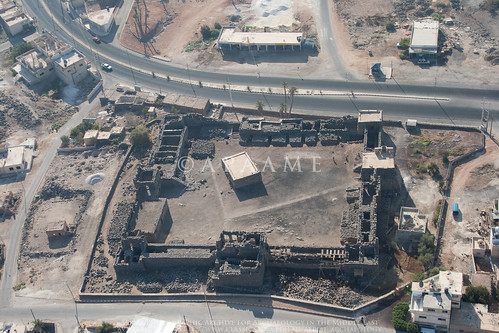
Qasr el-Azraq
Qasr el-Azraq today. APAAME_20080909_IAR-0205.
MacLean is an intriguing character and deserving of a fuller treatment which can to some extent be done thanks to a large number of small snippets of information available elsewhere. Here it is just possible to sketch a few details relevant to Aerial Archaeology at what is a very early date for such work in the Middle East – Poidebard only arrived in Syria to begin his flying programme in 1925.

MacLean, the son of Scottish immigrants to Canada, is said to have been:
“… teaching at the University of Manitoba when World War One broke out. He enlisted immediately, in August, 1914, in the Winnipeg Grenadiers and landed in England with the first Canadian contingent in October of that year. He was commissioned as an officer in the British Imperial Army in January, 1915, and served in France for eight months. In 1916 he was sent to the Middle East where he served in various capacities and in various countries - Mesopotamia, Persia, Arabia, and India. For the last year of the war he was engaged in political work, coming into contact with such personalities as Gertrude Bell, H. St. John Philby, Sir Percy Cox, and Col. T. E. Lawrence.”

He is described as having “served as staff captain under General Maude, being engaged particularly in intelligence and political work” and elsewhere he said he “arrived in Bagdad with the British army on 11 March 1917”. MacLean was soon moved westwards and is described as having been a “member of General Allenby’s staff when the British army marched on Jerusalem”.

In the magazine of his university he recounts the flight of 1922 which evidently included the flight to Azraq. Although he does not say so, he was evidently flying across Jordan and Iraq in one of the RAF aircraft of the newly developed Airmail Route from Egypt to Basra, initiated in June-July 1921. The few passengers carried were normally only service or important government personnel, implying MacLean had some influence.

MacLean explains he was in Baghdad as part of the celebration marking the laying of the foundation stone of the University of Baghdad and that he also met King Feisal. Returning west, his aeroplane had engine trouble and they had to land and spend a night in the desert.

There is much more one may add but two salient points to note are that MacLean is untraceable in the records of those who have spent many years researching military intelligence in the Middle East during the First World War. On the other hand, if he was – like that other oddity in the region, Richard Meinerzhagen, a fantasist, he nevertheless seems to have known enough people of influence to be given a flight to Azraq, taken on two trips on the new Airmail Route, perhaps also flown by the RAF in Iraq and supplied with some aerial photos for his lecture.

Sadly, one avenue of research is closed. MacLean’s sole child, a son, is long dead and had been estranged from his father for many years; the son’s children, brought up in France and French citizens, came to me for information about their grandfather.

But there must be some record of his First World War service and perhaps how that led to his flights in 1922. Perhaps he really did know Bell, Philby, Cox and Lawrence. In 1922 the senior British Political Officer in what they still called Transjordania was … Harry Philby. Shortly after MacLean flew across Jordan, Meinerzhagen crossed it on the ground. At the far end of the route, MacLean would have found the British residents of Baghdad included both Gertrude Bell (Oriental Secretary) and Sir Percy Cox (High Commissioner for Iraq).

Many of the personal details of MacLean’s long life and career have been traced as have his publications (including two books published privately). The gap is his military service.

– David Kennedy

Monday, 10 November 2014

Research: Pioneers - On a further personal note …

In a recent post on Insall, one of the three RAF pioneers in aerial reconnaissance over the Airmail Route and one of the first to publish an aerial photo of a Kite, I noted that a decade later he was the Station Commander of RAF Abu Sueir in Egypt where my father completed his flying training in 1936. I had long regretted that my father’s training at a Middle East base which was explicitly intended to produce pilots for service in the East, saw him posted to India for several years. Three of the other new pilots were posted to Iraq and one to No. 14(B) Squadron at Amman (killed shortly after in an accident).

In is now clear that although my father was never stationed in Iraq and Transjordan, he twice flew along the Airmail Route in those two Mandates. Putting together a few brief entries in his logbook, a handful of small photos and a postcard he sent to his brother-in-law back on the Northwest Frontier of British India, the episode is definable.
The 'Flying Boat' 'AWARUA'
About 17 July 1939 he was sent to Heliopolis in Egypt to collect and ferry back to India, one of the new Blenheim light bombers with which the RAF was being re-equipped. He recorded the flight on an Imperial Airways flying boat from Karachi via the Gulf and Habbaniya in Iraq to Tiberias on the Sea of Galilee and finally Alexandria – a two day journey. A few photos of the flying boat and a postcard from Tiberias:

Postcard from Tiberius.
I am having a marvellous time on board this flying boat ‘AWARUA’. We have just had Tiffin at Tiberias on Sea of Galilee.

By chance, that same flying boat was transferred the very next month to service in Australasia with Tasman Empire Airways Ltd (TEAL) on its NZ to Sydney route. As it happens there is a contemporary account now online of that delivery flight including:
Rapid refuel and then off towards Palestine where we land on the Sea of Galilee at Tiberius (sic), and here the skipper fills a special bottle with Galilee water to take to New Zealand for the christening of his new baby.
From Tiberius (sic) until we pass down into the Persian Gulf this next stretch is invariably hot and bumpy and the pipe line desert below never looks inviting especially when in a flying boat, …

My father’s logbook records his own flight back to India in August 1939, piloting his Blenheim:
5 August: Heliopolis – Habbaniya
5 August: Habbaniya – Shaibah
6 August: Shaibah – Sharjah
6 August: Sharjah – Karachi

That first stretch of 4 hours on 5th August would have largely retraced the Imperial Airways route across the Jordanian panhandle following the track alongside the oil pipeline which seems to have replaced the initial RAF track around the southern edge of the Harret ash-Shaam lavafield. Sadly he took no photos – almost 60 years before my own first flights in the same area.

- DLK

Thursday, 23 October 2014

Research: Gilbert Insall - Pioneer over Jordan … and Sinai and Iraq

Our recent flights over the Jordanian Panhandle have been a reminder of the RAF pioneers who discovered, photographed and published Kites in the 1920s. One of the principle trio was Gilbert Insall.

Insall had published a photograph of a Kite in 1929 (which has now been ‘rediscovered’ – Blog 'The First Kites') taken while he was commanding a squadron in Iraq. Several years later he was back in the Middle East as Station Commander of RAF Abu Sueir in Egypt, a Flying Training School. Edward Mole, the Chief Engineer at Abu Sueir in 1937-8, subsequently published a delightful autobiography of his RAF career including flights made with Insall. By then Insall was 42 and his enthusiasm for archaeology as undiminished. Mole records that Insall frequently flew out over Sinai, located sites, landed and set-to with the shovel and pick he carried with him. In case the C.O. got into trouble, Mole sometimes flew with him in another aircraft and was roped into the digging.
From above, the pattern of an old settlement could clearly be seen on the desert sand, and on sighting one, Insall would land nearby and dig for objects.

Later still, Insall and Mole flew together to Baghdad to visit RAF friends.
We set off together in two Audax aircraft to make the long trip across the featureless Arabian desert. There were no radio navigation aids in those days, but all we had to do was to find and follow the oil pipe line which ran straight as a die for hundreds of miles. We took with us all necessary desert flying equipment – emergency rations, water bottles, first aid kits – and Ghoolie Chits.

Interesting that by 1937-8, the air route across the Jordanian Panhandle had evidently shifted from the track and furrow ploughed for the RAF-pioneered Airmail Route of 12 years before along the southern fringe of the lavafield, to the much more straightforward line of the new oil pipeline further north. This was evidently the route followed by Imperial Airways when it took over the Airmail task from the RAF and explains the series of circular route-markers with numbers from (at least) 24 to 16 (as you flew east) (For an example see Flight 20141015 blog).

In Iraq, Insall had Mole fly him over Samarra so he could photograph it from the air – as he had had done when he flew Crawford there in 1928. Hopefully his aerial photos survive – his son had an RAF flying career, too, and is now a noted writer on archaeological work in Oman.

Abu Sueir, Sir P Sassoon, G Cpt Insall VC Inspecting Junior Term 1936.
On a personal note, Insall senior was the Station Commander at Abu Sueir when my father learned to fly there in 1936 and officiated at his Passing Out Parade.

- David Kennedy

Insall, G. S. M. (1929) “The aeroplane in archaeology”, Journal of the RAF College, Cranwell 9.2: 174-175.
Mole, E. (1984) Happy Landings, Shrewsbury.
Kennedy, D. L. (2012) “Pioneers Above Jordan. Revealing a prehistoric landscape”, Antiquity 86: 474-491.

Friday, 17 October 2014

Flight 20141015 - The Longest Day?

Flight track log from 20141015 - the survey of the basalt near Uweinid we conducted is particularly prominent.
A day’s flying always starts with the rigmarole of having to get through the security gate at Marka airbase. This year we were waved through on the first day as I was being asked if I wanted ‘Eight Squadron” and I said yes; not really knowing the exact details of what had just happened (as my Arabic is non-existent). The second day I blew it but today, having learnt what the question would be, and having memorized the Arabic for 8 Squadron, we sailed through. It has taken 16 years for this refined level of communication to be achieved – just as it has taken all these years to train a generation of young Huey pilots to understand what on earth these crazy archaeologists are doing orbiting sites hour after hour. Our pilots are now even taking their own pictures as they are becoming interested in what we see. All our orbits are to the right (as we sit on the right) but today was a “first” in that the pilot did a orbit to the left, especially for the co-pilot (seated on the left) to see what we had been looking at.

Qasr el-Uweinid. © `APAAME_20141015_RHB-0050.

So, what did we see? With over 2,000 images taken by the three of us (Bob, Becc and Mat) in 7.5 hours (see flight trace of today’s excursions) the highlights are particularly difficult to select. Our aim was to survey parts of the black basalt desert in the eastern part of Jordan, starting at Azraq and heading as far east as Ruweishid. Predominantly our targets in this region are prehistoric sites, but Qasr Uweinid always stands out as such a wonderfully situated Roman fort, on a promontory.
A Pendant with a close shave. © APAAME_20141015_RHB-0123.
Mainly we are photographing “Pendant”, “Kite” and “Wheel” sites – all named according to their shape; their date and function are less well known. The most striking Pendant (almost certainly a burial site) was this one – so nearly completely obliterated by a competing road bulldozed through since we last photographed.
A kite with wheel enclosure built over it. © APAAME_20141015_RHB-0463.

There were many Kites but the light this time of year highlights them so well – and rare to have both a Wheel and a Kite so entwined.

YAMOUK written in basalt across a mud pan landing ground. © APAAME_20141015_RHB-0303.
However it was the twentieth century remains which really took our breath away. In preparing for the flight Becc had marked two former RAF installations, visible on Google Earth but we had no idea what would survive. They are remnants from the time when Jordan was under a British mandate (then known as Transjordan), and the creation of the Cairo to Baghdad Airmail Routes. The first to be photographed was a landing ground with name "YARMOUK" created in stone, inlaid in the sand, to one side of the “runway”. The runway consisted of a very long stone-defined landing strip on the hard surface of the mudflat. To our amazement there seems to be almost no recent disturbance, a faint trace of the odd 4x4 wheel track, so prevalent elsewhere, but no sign of a bulldozer, thankfully.
The 'KENSINGTON' landing ground. © APAAME_20141015_RHB-0441.
The second site was one of the circular markers for the Cairo to Baghdad Airmail Route (one of the routes is described in R. Hill’s book on the subject from 1929) – number 17, but curiously this site also has inscribed in the sand the name "KENSINGTON". Both the number and the name are clearly visible on Google Earth. Our flight confirmed there has been little recent disturbance and we could also see what we interpret to be the remains of what must have been a camp, rectilinear stone-built platforms for tents. It is very unlikely any of the pilots from this period (1920s-1940s) are still alive but it would be fascinating to find out if any diaries exist of life at “Kensington”.

Remains of a camp near "Kensington". © APAAME_20141015_RHB-0443.

So, why the longest day? We left the Institute in Amman at 0630, and started flying at about 0715 and didn’t get back to Marka, after a long transit flight from Ruweishid, until almost 5 pm. Normally we do 4 to 6 hours flying (2 or 3 sorties) but today it was 4 separate flights, 3 re-fuellings for the aircraft but very little “fuel” for the pilots or ourselves and a total of 7.5 hours flying.
- Robert Bewley