Showing posts with label Middle East. Show all posts

Monday, 7 January 2019

Enter the U2 Spyplane Aerial Photography

Even if you are not old enough to remember the shooting down of Gary Powers and the huge international crisis that followed in 1960, you may have seen the more recent movie Bridge of Spies (culminating in the exchange of Powers for a Soviet spy).

A few years ago, while at a conference, Jesse Casana told me that U2 aerial photos of 1958-1960 had now been declassified and included aerial photos – not the satellite photos of the Corona programme and its successors, of parts of the Middle East. Declassified but not catalogued and hard to actually access.

Emily Hammer and Jason Ur have created a spatial index to the declassified U2 Aerial Photos for the Middle East available in the National Archives (NARA), and this can be accessed at https://scholar.harvard.edu/jasonur/u2-aerial-photography-middle-east

At least one product of that work has now been published (Hammer and Lauricella 2017) – though not by Jesse Casana. It is plainly a laborious task still to use the material but the quality is very good and – of particular interest to me, is a flight of 1960 down the Jordanian panhandle from east to west and over and beyond Azraq. The Hunting Aerial Survey of 1953 is a little earlier in date but the quality is evidently poorer and it did not extend much east of Azraq. There will be particularly useful work to be done on that key area west of Azraq where the HAS material is very useful but poor quality combining it with the better U2 material of parts of the area. It is precisely there – with better quality soils and more precipitation, that the expansion of agriculture and removal of the basalt covering has damaged and destroyed many hundreds of sites of all kinds. As we know from our AAJ project, it is often difficult today to find traces of even the large Kites visible on the Hunting photos of 1953 and many have gone entirely.

Hammer, E. and A. Lauricella. 2017. “Historical Imagery of Desert Kites in Eastern Jordan.” NearEastern Archaeology 80.2: 74-83. Available on JSTOR.
Hammer, E. and J. Ur. In press. “Near Eastern Landscapes and Declassified U2 Aerial Imagery.” Advances in Archaeological Practice.


-DLK

Wednesday, 3 September 2014

Publications: Kites in 'Arabia' (iBook)

Apple iBooks has just published (1 September) a new book by Prof. David Kennedy with Rebecca Banks and Emergent Form's Paul Houghton on Kites in 'Arabia'.

Kites in 'Arabia'
David Kennedy with Rebecca Banks and Paul Houghton
September 1, 2014
iBooks for iPad or Mac OS X 10.9 or later
Emergent Form
225 pages
US$4.99/ AU$5.99/ £2.99
Edit 25/20/2016 - the iBook is free to Download.

The book offers an approachable survey and analysis of the stone built structures known as Kites  found throughout Arabia - the huge arid region extending from south-eastern Turkey through Syria, Iraq, Jordan and Saudi Arabia to Yemen.  The volume examines Kites from their first discovery by the RAF pilots who were the 'Pioneers' of aerial photography in the inter-war period in Transjordan to recent research and interpretation conducted by various professionals in the field. Distribution, form and function of the Kites is discussed and extensively illustrated with references provided throughout. The volume benefits from David Kennedy's long established interest and passion for aerial photography and archaeology in the Middle East, and draws on the extensive reconnaissance performed by the Aerial Archaeology in Jordan Project and historical imagery research of the APAAME Project. The book also includes extensive appendices illustrating types and locations of Kites across 'Arabia', and historical accounts of Kites by early explorers in the Middle East.

The medium of iBook was chosen for two primary reasons: accessibility and inclusion of illustrations. We have made the iBook available for just US$4.99/ AU$5.99/ £2.99 to make the publication affordable. Images have been profusely included to illustrate the features described, something that would have astronomically increased publication costs in a printed edition. Moreover the electronic format allows for interactive features which enhance the illustrative elements and for video interviews and footage taken from the helicopter.

Heavy on content, the iBook does come out at roughly 1GB to download, but fortunately will only ever be as heavy as carrying around your laptop or iPad.

Monday, 10 March 2014

Archive: UPenn Museum of Archaeology and Anthropology Film Archives

"The formidable mountains of Arabia Petraea still loomed miles away."


The Film Archives of the University of Pennsylvania Museum of Archaeology and Anthropology have been digitised and made available online thanks to the generosity of the 'Internet Archive'.

A silent film by Arthur and Kate Tode from 1930 is an interesting glimpse of travel in the Middle East between the wars. There are some stunning views of Petra [4:01] including a rare occurrence of  snowfall [17:05] (apparently the first time it had snowed in Petra in 30 years), footage of the Umayyad Mosque of Damascus [24:02], the Ctesiphon Arch [33:00], the ruins of Babylon [37:14] and Ur [43:00], and also some aerial footage towards the end [50:30].

The Internet Archive site provides a transcript of the silent film's narrative.

You can access the University of Pennsylvania Museum of Archaeology and Anthropology Films collection at The Internet Archive here.

You can access the Museum website here: http://www.penn.museum/archives.html/film-archives.html

Friday, 28 February 2014

Archives: The G. Eric and Edith Matson Photograph Collection

The G. Eric and Edith Matson Photograph Collection is housed at the Library of Congress, Washington.

The collection began as a result of the founding of a photo department at the American Colony in Jerusalem c. 1898, and continued after the break up of the Colony under the direction of G. Eric Matson and his wife Edith as the Matson Photo Service. It was donated to the Library of Congress by Eric Matson in during the 1960s.
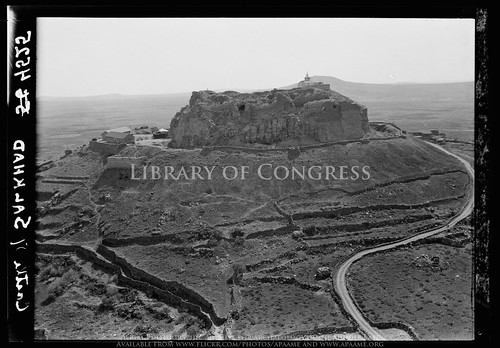
Castle of Salkhad. Closer view of the picturesque castle

It is a rich source of historical images of the Middle East. Though the majority of the items depict Palestine where the Colony and the Matsons were based, there are numerous historical photographs of Amman and other locations in Jordan, as well as other major centres in the Middle East. Of particular interest are the numerous aerial photographs taken - many on the Cairo to Baghdad Airmail Route.

The majority of the collection is in the Public Domain thanks to the original conditions of the donation. The fantastic digitisation program by the Library of Congress means you can access those images online: www.loc.gov/pictures/search/?st=grid&co=matpc.

We have gone through the collection and found the majority of the aerial photographs and created an individual set in our Flickr archive: http://www.flickr.com/photos/apaame/sets/72157635656377565/. Where not already known we have endeavoured to identify all of the sites in the photographs and georeference them. In addition to this you will find the Library of Congress online database reference information. In this Flickr set we hope to highlight the part of the collection that is aerial photography, as well to those that depict archaeological sites. We have paid particular attention to the ruins of Amman, ancient Philadelphia.

For more information on the collection please go to the Library of Congress website: www.loc.gov/pictures/collection/matpc/about.html. If you wish to access the original photographs or want unwatermarked digital copies please visit the Library of Congress website. We have provided the reference numbers for the items and links to their item records for this reason. APAAME holds no rights to these images and merely wishes to add to the information held regarding them in the Public Domain.

Saturday, 18 January 2014

Roman Archaeology Group Free Lectures: Saturday, 8th February.

The Roman Archaeology Group has arranged for two illustrated lectures to be presented on Saturday, 8th February. All are welcome.

2 Free Illustrated Lectures on: The Emperor Justinian and Petra, Jordan.
Saturday, 8th February 2014.

1:30pm: "Justinian's Empire" presented by Dr. Michael Champion.

2:30pm: Afternoon Tea.

3:00pm: "Western Travellers to Petra in the 19th Century" presented by W/Prof. David Kennedy.

N.B. Lectures are FREE, however there is a small charge for the refreshments served at the mid-session break: $7pp (RAG members) / $10pp (non-members)

Booking for catering purposes is ESSENTIAL.
Please RSVP by Wednesday 5th February to Norah by telephone 9281 4613 or by email: coopsathome@optusnet.com.au

For more details please see the events page of the Roman Archaeology Group blog here.

Thursday, 9 January 2014

Website: Monuments of Syria

http://monumentsofsyria.com/
The eyes of the world seem fixed on Syria presently, it is a tragedy that it could not be for different reasons than those of the conflict currently destabilising the lives of so many.

Ross Burns, author of 'Monuments of Syria' and 'Damascus- a history', has recently launched an accompanying website to his published work on Syria. 'Monuments of Syria' provides an index of historical places and sites with photographs. It provides a valuable insight to many sites of historical interest that few currently are able to visit. Here, so many periods, civilisations and faiths are represented.
"Few countries can match Syria in the richness of its historical remains. In the zone west of Aleppo, for example, over 600 Byzantine-era villages survive, often with multiple churches with walls up to their rooflines. There is practically no era not represented in Syria. Palmyra, the great caravan city at the westernmost point of the Silk Road, still slumbers in the desert, its beautifully carved limestone as crisp and dramatic as 2000 years ago. Magnificent reminders of the folly of past confrontations, including the Crusades, survive in the great fortifications that are scattered across the country — the Krak des Chevaliers; the great Islamic citadel that crowns Aleppo; the refuges of the ‘Assassins’ hidden away in the coastal mountains; or the Damascus Citadel that sustained the long Muslim resistance to the Crusades. Not to be overlooked are the many mosques and madrasas, often tucked away quietly in backstreets or buried within the busy suqs (markets) of the major centres."
Through efforts like this much knowledge is kept alive, for Syrians and the world alike. Hopefully when the spectre of war departs from the land the corpus will be expanded and studied further.
Visit http://monumentsofsyria.com/