 |
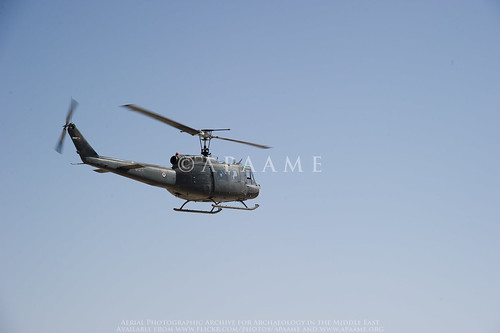
| One of the RJAF Hueys in flight during the 2010 season. Photographer: Don Boyer. APAAME_20101016_DDB-0045. |

Showing posts with label Looting. Show all posts
Showing posts with label Looting. Show all posts
Tuesday, 14 June 2016
AAJ May 2016 - Highs, Lows, and Goodbyes to the Hueys
When we are in Jordan we will squeeze in any opportunity to fly, but this year it was particularly important to do a few flights as we have sadly lost the use of the wonderful beast of helicoptering - the Huey, and we had to test our new machines and pilots of the Eurocopters.
The Huey has been our principal form of aerial reconnaissance since the Aerial Archaeology in Jordan project started in 1997. The advantages of the Huey were its spacious interior, large opening (once the door was open) and outward facing seats that allowed four photographers to operate together. Given these machines had been in operation during the Vietnam War (see our blog 'I Love the Smell of Nabataea in the Morning'), and one had a bullet hole to prove it, we knew we would have to move on eventually. They had their quirks, like the communication systems being flakey, shaking you about so that you could feel the movement for several hours after landing, and the noise! We felt a pang of grief for the loss of a trusted friend that had transported us over the varied sites and landscapes of Jordan. If anyone has a few million pounds to service a small fleet of Hueys for us, I am sure we could make good use of it!


Friday, 24 October 2014
Flights 20141012-13 - Blink and you will miss it
One of the main aims of the Aerial Archaeology in Jordan Project is to photographically record archaeology in Jordan – a record through which it can be monitored.
This year has provided some highs and lows.
Reconstruction work has occurred at Qasr el-Mshatta near Queen Alia International Airport.
A possible Roman column quarry has somehow survived (so far) amongst a massive modern limestone quarry – and a ground visit found another quarry site on an adjacent hill. But how long will they survive the expanding modern quarry?
Two of the original columns of Machaerus have been restored and inaccurate representations removed.
The building of a pilgrim hotel has destroyed one of the Roman siege camps (Roman Camp P) surrounding the site of Machaerus. The location no doubt was chosen for its excellent view over the ancient site. It is likely that very reason had once made it the ideal location from which the commander of the Roman siege forces possibly directed his assault.
Necropoli have been the target of looters since Antiquity, but modern looting is also evident – individual shafts at Khirbet Ain, honeycombing of hillsides at Pella and the systematic looting of Dead Sea sites Fifi, Al-Nage’a and Bab edh-Dhra.
This year has provided some highs and lows.
Reconstruction work has occurred at Qasr el-Mshatta near Queen Alia International Airport.
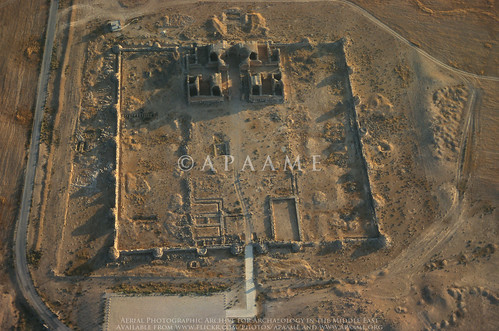 |
| Qasr el-Mshatta in 1998. © APAAME_19980513_RHB-0054. |
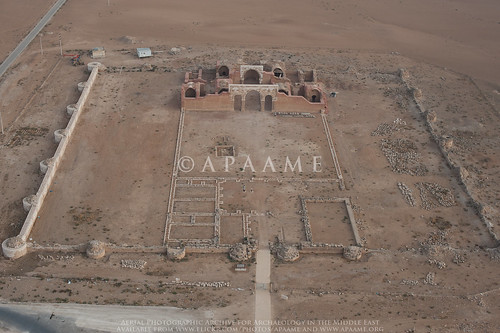 |
| Qasr el-Mshatta in 2014. © APAAME_20141013_RHB-0012. |
A possible Roman column quarry has somehow survived (so far) amongst a massive modern limestone quarry – and a ground visit found another quarry site on an adjacent hill. But how long will they survive the expanding modern quarry?
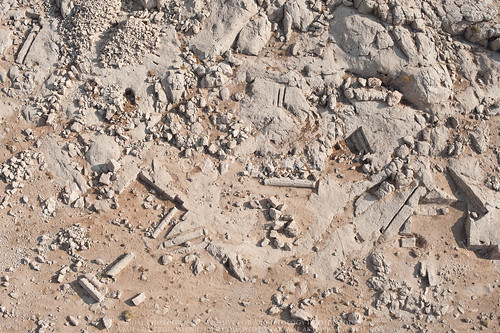 |
| Quarry. © APAAME_20141013_RHB-0467. |
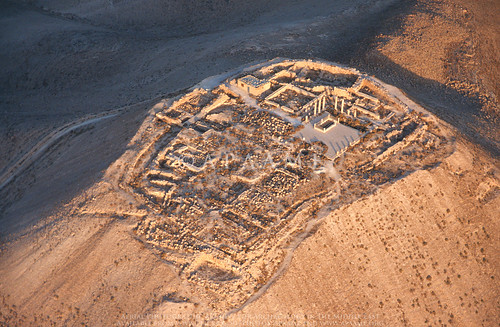 |
| Machaerus in 2006. © APAAME_20060910_DLK-0005. |
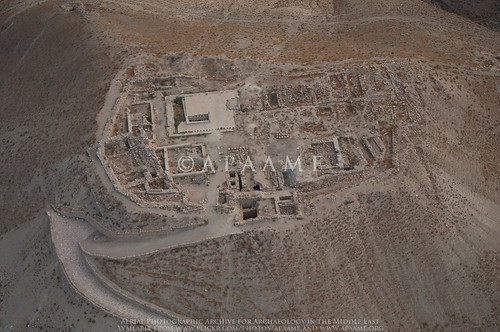 |
| Machaerus in 2014. © APAAME_20141013_MND-0086. |
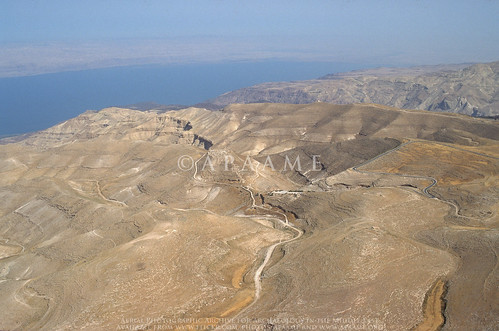 | |
| Machaerus in 1998. The faint trace of Roman Camp P can be seen on the peak in middle ground right. © APAAME_19980517_RHB-0071. |
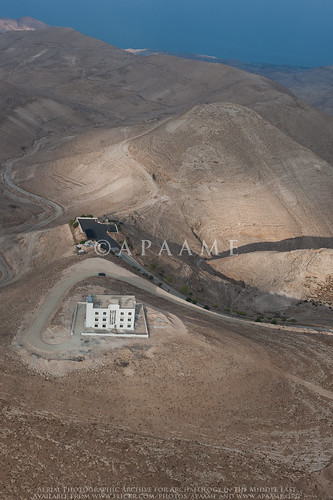 |
| Pilgrim Hotel in foreground of Machaerus in 2014. © APAAME_20141013_RHB-0032. |
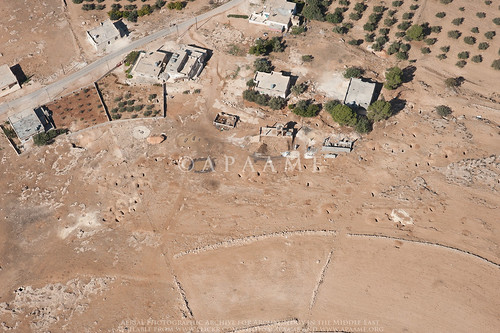 |
| Looting shafts at Khirbet Ain. © APAAME_20141012_REB-0235. |
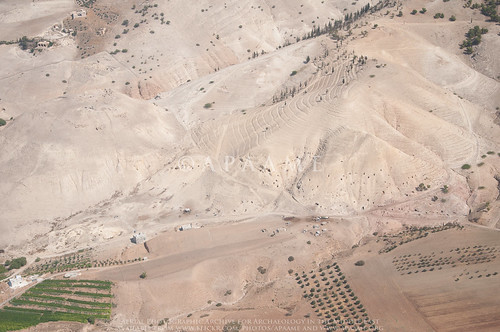 |
| Looting shafts in the hillsides around Pella. © APAAME_20141012_MND-0384. |
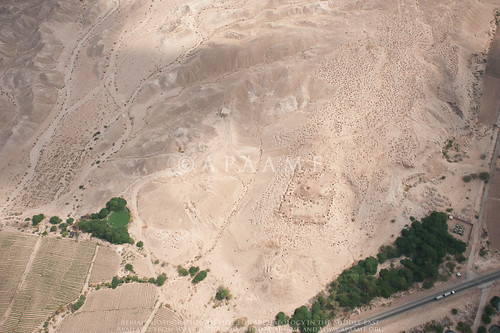 |
| Systematic looting of Fifi. © APAAME_20141013_REB-0277. |
Tuesday, 14 October 2014
Flight 20141013 - Flying South
 |
| Qasr Mshatta under cloud - © APAAME_20141013_REB-0028 |
 |
| Machaerus - © APAAME_20141013_RHB-0063 |
 |
| Extensive looting near Safi - the site of Maqbarat Al-Nage'a - © APAAME_20141013_REB-0307 |
 |
| Umm er-Resas - APAAME_20141013_REB-0224 |
 |
| Roman (?) Column Quarry east of Marka APAAME_20141013_MND-0768 |
- Robert Bewley
Thursday, 6 October 2011
Monitoring the Past … and Present
 Umm el-Jimal (APAAME_20111002_DLK-0523)
One of the key objectives of any aerial reconnaissance programme in archaeology is to monitor sites and landscapes in danger from development. As Jordan has one of the fastest growing populations and a very rapid development of its landscape, the task is especially important here.
One increasingly obvious sign at many sites in the last few years is the evidence for the discovery …. and looting of ancient cemeteries. We have observed it at several sites in every part of the country.
This photograph was taken three days ago (Sunday 2 October 2011) at the Nabataean-Roman-Umayyad town of Umm el-Jemal in northern Jordan. It is one of three cemeteries revealed by the open pits of excavated graves.
-DLK
Subscribe to:
Posts (Atom)