Thursday, 29 September 2011

Azraq Camera

Much of the work behind each flight begins several days before with the preparation of the flight plan. A list of all the sites we intend to visit is compiled and entered on Google Earth. The route for the flight is then uploaded into two Garmin GPS96C receivers that we will use to navigate on the flight.

An APAAME Nikon D70


The APAAME team use Nikon cameras when photographing sites from the air. Usually the team have two Nikon D70s with 28-105mm Nikkor lenses and at least one Nikon D3 with a 24-70mm Nikkor lens on each flight. The preferred technique for aerial photography is to shoot in shutter priority mode with shutter speeds in the range of 1/500s to 1/1000s of a second.

The photographs themselves are obviously of reduced value without their associated metadata (such as latitude and longitude), so a great deal of work is done post flight to ensure that the images are correctly tagged and cataloged. The D3s have GPS capability (using Geopic II), which is attached via the hot-shoe and cable.

To geoencode the photographs taken by the D70s, we first record the time displayed by the GPS receivers by photographing them with each camera at the start of the flight. This allows us to correct the time data associated with each image to make it consistent and accurate. The GPS position of each photograph is then automatically added by matching the time of image capture to the position on the track log from the GPS receiver, using HoudahGeo software. Finally, the images are loaded into Adobe Lightroom 3 for any necessary corrective actions before being uploaded to Flickr.

Wednesday, 28 September 2011

I Love the Smell of Nabataea in the Morning

This morning the team made a short but glorious flight in a Bell UH-1H Iroquois from 8 Squadron, Royal Jordanian Air Force - crewed by Lt. Col. Husam and 2nd Lt. Salem.

This particular aircraft - 809 - was acquired by the RJAF in 1995, before which it had a long and storied career with the US Army. 809 is a Model 205 long fuselage variant that was delivered from the factory in Fort Worth, Texas in 1970.

The aircraft bore the number 68-15284 in US service and is a Vietnam veteran, having seen action at Lai Khe in 1970-71 with the 227th Assault Helicopter Battalion of the 1st Cavalry Division (Airmobile). It also acquired striking artwork and the name of "Chickenman America" during its tour of duty.

809/284 is piece of flying history and we feel grateful to be able to experience it in the expert hands of the RJAF.

Planet dust...

Three Bell UH-1 'Hueys' on the tarmac at RJAF air base Marka - a crewman straps
down the rotors on our chopper (809) following the abortive take-off and landing.

In an eloquent reminder of how best-laid archaeological plans can change overnight, our first flight of the year has been cut down to a 5 minute tour of Amman due to the sudden arrival of an unseasonably large cloud of dust from the Syrian desert. Having taken off in our UH-1 'Huey', the magnitude of the cloud soon became apparent, and our experienced pilot Lt. Colonel Husam returned to Marka immediately.

Dust obscures the control tower at Marka air base.

We are now back at base camp, eagerly watching the weather radars at http://oiswww.eumetsat.org/IPPS/html/MSG/RGB/DUST/EASTERNAFRICA/index.htm. With any luck the worst of the dust will have moved west overnight, and we'll be able to fly our planned route tomorrow.

Dust plumes (in pink) over Jordan as of 10am. Image from http://oiswww.eumetsat.org

Tuesday, 27 September 2011

Let the flying begin

The long wait for our next flying season is almost over. David, Simon and myself have arrived in Jordan and have pitched base camp in the laboratory of the British Institute in Amman. We set out for Marka Air Force Base at 5:30am tomorrow morning (most archaeological sites appear at their best in raking morning light), and will fly over more than 100 targets in the north-west corner of Jordan, photographing many of them from the air for the first time.

The British Institute in Amman from above
APAAME_20100601_DDB-0575


David has sent me his list of target sites for this flight, some of which he has noted from academic articles and reports, and others that have been requested by researchers interested in specific aspects of Jordan's history. We are also revisiting several sites - including Jarash (ancient Gerasa) and Umm el Jimal ('The Mother of Camels' - a roman town) - that we have already photographed, to record new excavations and details the impact of continuing development that affects many sites in Jordan.

Route planning using Google Earth

All of these sites are put into an overall flight plan using MacGPS pro, and are then loaded into our two avionic GPS units, which allow us to navigate and direct the pilots to each site in turn. We generally fly in a circle over each site to allow us to photograph it from every angle. We aim to have the photographs up on our online archive as soon as possible (usually within a couple of days), so keep an eye out for these!

Simon Rutter tests out one of our Nikon D70s in preparation for the next morning's flight

The Renewal of Arabian Fauna

Captive breeding programs have seen some species come back from the brink of extinction. The Environment Agency-Abu Dhabi has recently announced they are ready to release the Arabian Oryx, known locally as the 'Al Maha', back into the wild (link to ABC Environment Feature Article), and local nature reserves such as the Ajloun Forest Reserve have been acting to reintroduce other species such as Roe Deer which had become locally extinct in Jordan (see The Royal Society for the Conservation of Nature, Jordan, Website).

The stone structures known as Kites are believed to have been traditionally used for hunting these local ungulates (hoofed mammals) of Arabia, including gazelle, deer, oryx and onager, as well as ostrich. We know the wild population dwindled rapidly in the early 20th century due to human and environmental factors, such as hunting and reduction of natural habitat. Accessing the impact on the population caused by hunting using Kites is more difficult to access as no sites have been found directly linking Kites with the slaughter of these animals, but an excavation of a fourth millenium BC deposit of bones found in North-eastern Syria published in an article in PNAS may provide some insight into how hunting using Kites may have impacted the Persian Gazelle population in antiquity.

Monday, 26 September 2011

Ancient Jordan from the Air

A wide range of photographs from our archive are now available in David Kennedy and Robert Bewley's Ancient Jordan from the Air, along with extensive background reading on the complex multi-layered history of Jordan and the many varieties of sites we find. The book is available from Oxbow books and Amazon.

Monday, 19 September 2011

Wheels at the Azraq Oasis

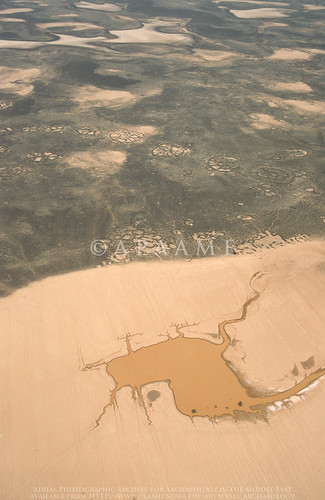
Outline of a group of wheels near the Azraq Oasis. This group consists of 38 separate wheels.
Drawn: Rebecca Banks
This group of wheels is found along side a mud pan near the Azraq Oasis. It is one of four such large groups in the area. The group shows a huge amount of variation in style between individual wheels, some being merely walled enclosures, some having divisions, and some also including outer rings and cairns and/or hides. Some are much better preserved than others with walls crumbling from age as well as contact with the modern world, including bulldozed tracks through the site.