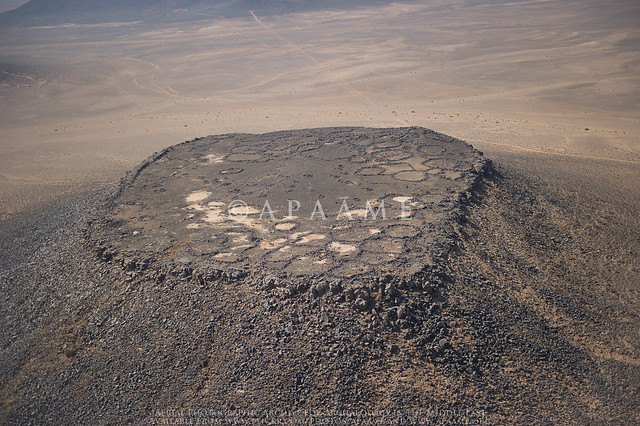
A simple Wheel (Aritein Wheel 5) with nine spokes radiating from a central point and no hub.
The Wheels of northeast Jordan are so-called due to their most common form, a circular structure with low stone walls, and lines radiating from a central point like spokes. Little is known of these sites beyond their type and location, as there has been little archaeological investigation.They were probably amongst the 'circles' mentioned by Rees in 1929. In the 1970s they were studied simultaneously by Helms and Betts (who called their examples 'Jellyfish') and Kennedy and Riley (who preferred 'Wheel (enclosure)'). There are large numbers across the Harrat ash-Shaam of Jordan, and the numbers possibly exceed 1000.
 |
| Aritein Wheel 2 seen from ground level. The crumbling low walls can be seen just before the horizon. Photo: Karen Henderson. |
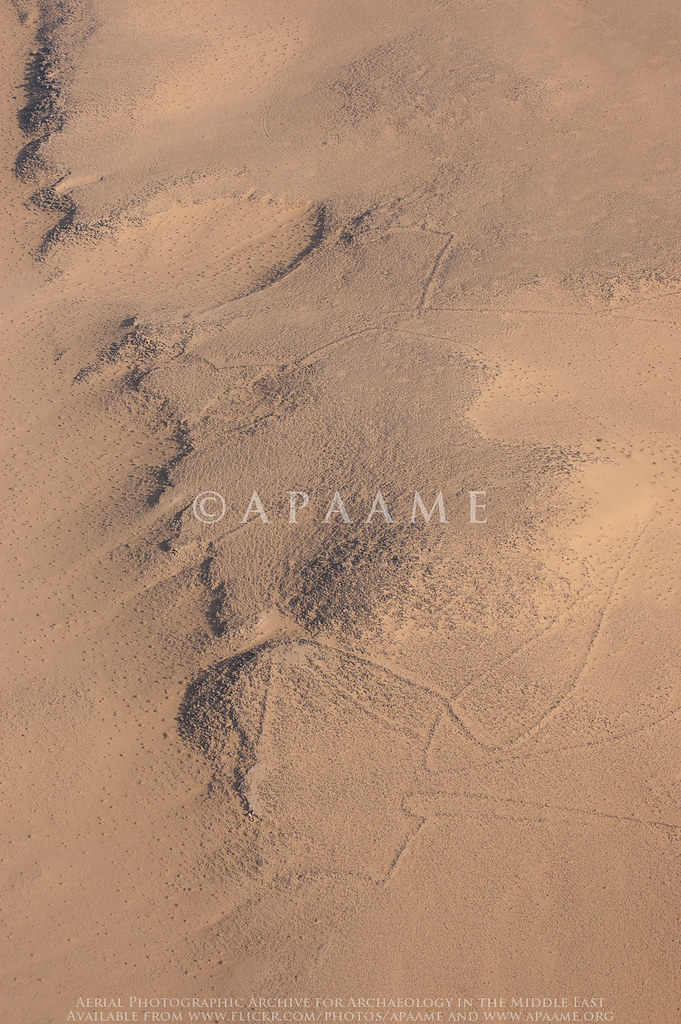
The walls are very low on the Wheels, and are built without mortar or shaping of the stone. Although they are well known from aerial photographs and satellite imagery, the structures themselves can be easily missed in the landscape. Betts (1984: 29) notes that when surveying Wheels on the ground, they are so ephemeral as to go unnoticed if one does not already know they are there. The above photograph shows the very slightly raised and darker rocks of a Wheel in the Aritein area, demonstrating how hard they can be to see on the ground.
A plan drawn from a very faint Google Earth image of a singular Wheel found outside the basalt area.
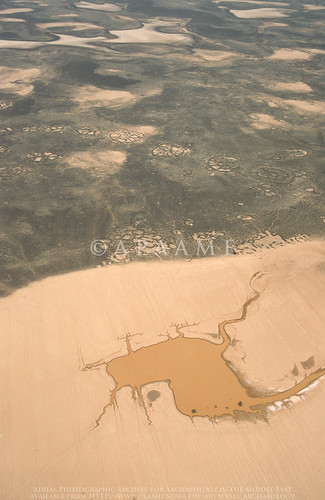
Wheels have large variations in size and type, but they seem to be almost entirely confined to the Harrat ash-Shaam. The only possible example found just outside of the basalt cover in the north of the panhandle is extremely faint and hard to identify. Despite its faintness, the structure appears to be of a coommon form – a large central open hub with straight spokes, and possibly an exterior wall or ring of Cairns around the outside. The mud pan that it sits on makes it very difficult to see, and it is possible there are other examples in the limestone steppe east and west of the basalt that have not been positively identified as yet.
Wheel Typology. Drawn: Karen Henderson.
A Wheel typology (above) has been constructed for the basalt area of Jordan based on several defining features: the type or absence of a central hub; number and straightness of the dividing spokes or walls; presence or absence of Cairns within and/ or surrounding the main internal structure; shape of the main structure; and external wall features. Size is another defining factor. Each of the below features appear in many different combinations and configurations. So far, the types do not seem to have regional differences within the basalt, but there seems to a greater number of them in the southwest and central basalt.
Generally, the structures are built on slopes or hills, although unlike Cairns and Pendants, they are not usually on highly visible ridgelines. They are often found on or near the Kites, either overlying the tails, or built within a Kite head, and it is this which suggests a later date for Wheels than Kites. They are also often grouped together, particularly in areas with a heavier basalt cover, like Azraq, Safawi and Aritein. There does not seem to be a particular pattern to their type when grouped in such a way, as there is large variations in size and shaped, as well as defining features across the clusters.
A large variety of Wheels grouped together near the Azraq Oasis, where these kind of groups appear to be most common. Image: Google Earth.
There is no stratified archaeological evidence available for these structures, and what little there is was collected during archaeological surveys focused on other sites or structures in the 1980s. The related Wheel structures within these survey areas were commented on but little information was collected, as they were not the focus of the investigation. Still, both Helms (1981: 50) and Betts (1982: 186) attribute a Neolithic date based on artefact assemblages. Helms does not give details, merely saying that recognizable Neolithic implements (7th-5th millennium) were found within the Wheels. One point here, however is that it is sometimes difficult to distinguish his comments in relation to the Wheels with those pertaining to the ubiquitous corrals, a different site type entirely.
Betts devoted a paper to the structures she refers to as ‘Jellyfish’, and it is these sites which are referred to in Helms’ earlier work (above). She notes the propensity of these sites to be built on the higher plateaus and slopes of basalt, and also the relationship to the Kite sites. Like Helms, she suggests a habitation function for the Wheels. However, neither of them argue this convincingly, since most of their assumptions are based on placement and structure. Betts notes that they are often placed on higher ground above water sources in areas that are more difficult to build on. She suggests this is to provide protection from ‘belligerent peoples’, but it makes little sense to build an enclosure for sleeping and protecting your animals in a place that is away from water, and hard to access.
In short, there is very little known of the Wheels in relation to their function and age. However, much more evidence is emerging in relation to their placement, size and type, and these features may allow a better understanding, and perhaps allow for more reasonable suggestions of function.
-Karen Henderson
References:
* Betts, A.V.G. (1982) ''Jellyfish': prehistoric desert shelters', Annual of the Department of Antiquities, Jordan XXVI: 183-188
* Betts, A.V.G. (1984) 'Black desert survey, Jordan: second preliminary report', Levant XVI: 25-34
* Helms, S. (1981) Jawa. Lost City of the Black Desert. Methuen, London.
* Rees, L.W.B. (1929) 'The Transjordan Desert', Antiquity 3: 389-406.
* Riley, D.N. (1982) 'Antiquities recorded by old photographs taken by the Royal Air Force of the desert near Azraq Duruz', in Kennedy, D.L. (1982) Archaeological Explorations on the Roman Frontier in North-east Jordan, Oxford (BAR, Int. Series 134): 345-355.